
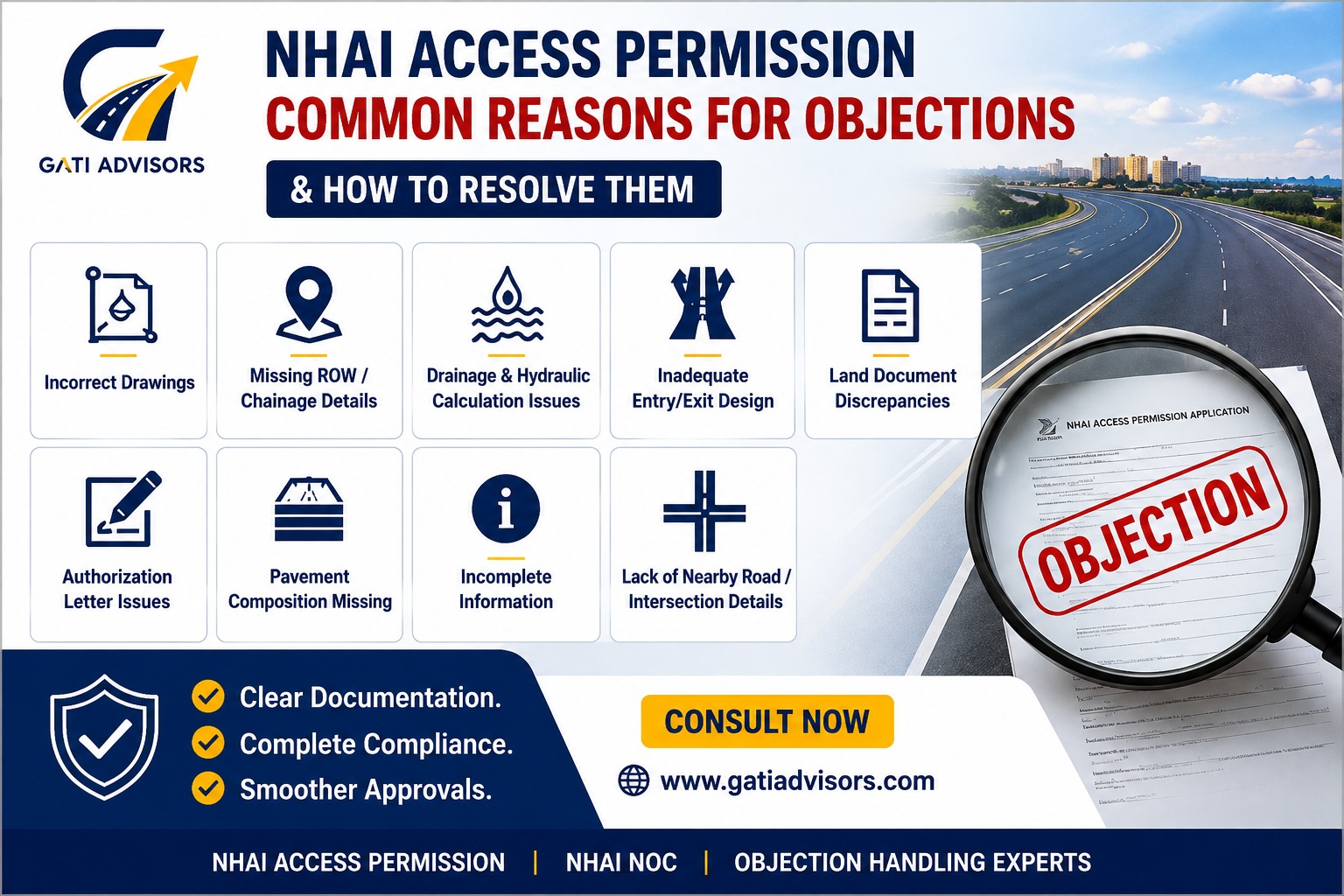
Submitting an NHAI access permission application is not always the final step. During technical scrutiny, the concerned NHAI office may raise observations or objections requiring clarification, additional documents or revised drawings.
An objection does not necessarily mean that the project cannot proceed. In many cases, it means that the proposal needs additional information or compliance with the applicable technical requirements.
The key is to understand each observation and respond to it accurately.
What Is an NHAI Objection?
An NHAI objection is an observation raised during scrutiny of an application.
It may relate to:
- Documentation
- Technical drawings
- Highway access
- Drainage
- ROW
- Chainage
- Road geometry
- Existing intersections
- Authorization
- Hydraulic calculations
- Pavement details
The exact objection depends on the proposal and the reviewing authority.
1. Proposed Plot Pictures
NHAI may ask for photographs of the proposed site.
Why?
Photographs help establish actual site conditions, including:
- Existing road
- Plot frontage
- Highway condition
- Existing access
- Drainage
- Nearby development
How to Comply
Provide clear, recent photographs that adequately represent the site and its surroundings.
2. Layout Plan and Highway Access Details
One of the most important objections can relate to the site layout and proposed access.
The drawing may need to clearly show:
- Highway
- Chainage
- ROW
- Plot boundary
- Entry
- Exit
- Service road
- Acceleration lane
- Deceleration lane
- Road geometry
- Existing intersections
How to Comply
Submit a technically coordinated drawing containing the requested information and ensure that the drawing matches actual site conditions.
3. Drainage Plan
Drainage is an important consideration because development should not adversely affect highway drainage.
The proposal may need to show:
- Existing drainage
- Proposed drainage
- Cross-drainage arrangements
- Flow direction
- Connections
- Relevant sections/details
Hydraulic Calculations
For certain projects, hydraulic calculations may also be required to demonstrate the adequacy of the proposed drainage arrangement.
4. Land Ownership Documents
NHAI may ask for documents establishing the applicant’s right over the property.
These can include:
- Sale deed
- Lease deed
- Jamabandi
- Mutation/Intkal
- Khata/record of rights
- Khasra details
- Other relevant land records
Important
The name, area, khasra details and other relevant information should be consistent across the documents and drawings.
5. GST Certificate
Depending on the application and applicant, GST documentation may be requested.
Provide a clear and valid copy where applicable.
6. Strip Plan
A strip plan can be important for understanding the relationship between the proposed development and the highway.
It may need to show:
- Highway ROW
- Existing intersections
- Intersecting roads
- Proposed access
- Relevant highway chainage
- Surrounding access points
For some proposals, the authority may specifically require the strip plan to cover a defined distance on either side of the site.
7. Authorization Letter / Power of Attorney
Where a consultant or authorized representative is submitting or signing documents on behalf of the applicant, an appropriate authorization/POA may be required.
Make sure:
- Applicant details are correct
- Authorized person’s details are correct
- Signatures are properly executed
- The document corresponds with the application
8. Hydraulic Calculations
For projects involving significant drainage arrangements, the authority may require hydraulic calculations.
These calculations help demonstrate that the proposed drainage arrangement has adequate capacity for the relevant design conditions.
A qualified technical professional should prepare such calculations where required.
9. Pavement Composition
For acceleration/deceleration lanes or service roads, the authority may ask for pavement composition details.
The proposal may need to identify relevant pavement layers and design details as applicable to the project.
These should be prepared by the appropriate technical professional based on project requirements.
Why Do NHAI Applications Receive Objections?
Common reasons include:
Incomplete Documents
A required document may be missing.
Drawing Mismatch
The site drawing may not correspond with land records or actual site conditions.
Missing Highway Details
Chainage, ROW or existing road information may not be clearly represented.
Inadequate Technical Information
Drainage, pavement or geometric details may be incomplete.
Poor Coordination
Different drawings may contain inconsistent information.
How to Prepare a Good Objection Reply
A good compliance reply should be:
Point-wise: Address each objection separately.
Specific: Clearly explain what has been added or corrected.
Supported: Attach the relevant drawing/document wherever required.
Consistent: Ensure all revised documents contain matching information.
Professional: Use clear and concise technical language.
Example Structure
A professional reply can follow this structure:
Objection 1: Proposed Plot Pictures
Compliance: Recent site photographs have been attached for reference.
Objection 2: Layout and Access Details
Compliance: The revised drawing includes the proposed access, highway chainage, ROW and relevant access arrangements.
Objection 3: Drainage
Compliance: Drainage arrangements have been incorporated in the submitted drawing, along with relevant technical details.
This format makes it easier for the reviewing authority to identify the compliance.
Should the Entire Drawing Be Recreated?
Not always.
If an existing drawing already contains the required information, it may be possible to identify and clarify the relevant details instead of unnecessarily preparing a completely new set of drawings.
However, the final approach should depend on the specific objection and requirements of the concerned authority.
How Gati Advisors Helps With NHAI Objections
Gati Advisors assists clients with:
- Reviewing NHAI observations
- Preparing point-wise compliance
- Coordinating revised drawings
- Document compilation
- Highway access-related technical requirements
- Application follow-up
- NHAI NOC/access permission consultancy
Our objective is to make the compliance process organized and technically clear.
FAQs
Does an NHAI objection mean my application is rejected?
Not necessarily. An objection generally means that clarification, additional information or compliance is required. The final outcome depends on the complete proposal and applicable requirements.
How should I reply to an NHAI objection?
Address every observation point-by-point and provide the relevant documents, drawings or explanations.
Can drawings be revised after an objection?
Where required, revised drawings can be prepared and submitted as part of compliance, subject to the applicable process.
Can Gati Advisors handle NHAI objection compliance?
Yes. Gati Advisors provides consultancy support for reviewing observations, coordinating documents/drawings and preparing compliance for NHAI access-related applications.
Facing an NHAI Objection?
Don’t simply resubmit the same documents.
First understand what the authority has asked for, why it has been asked, and how the compliance should be presented.
Contact Gati Advisors for NHAI access permission, NHAI NOC consultancy and professional objection-compliance assistance.