
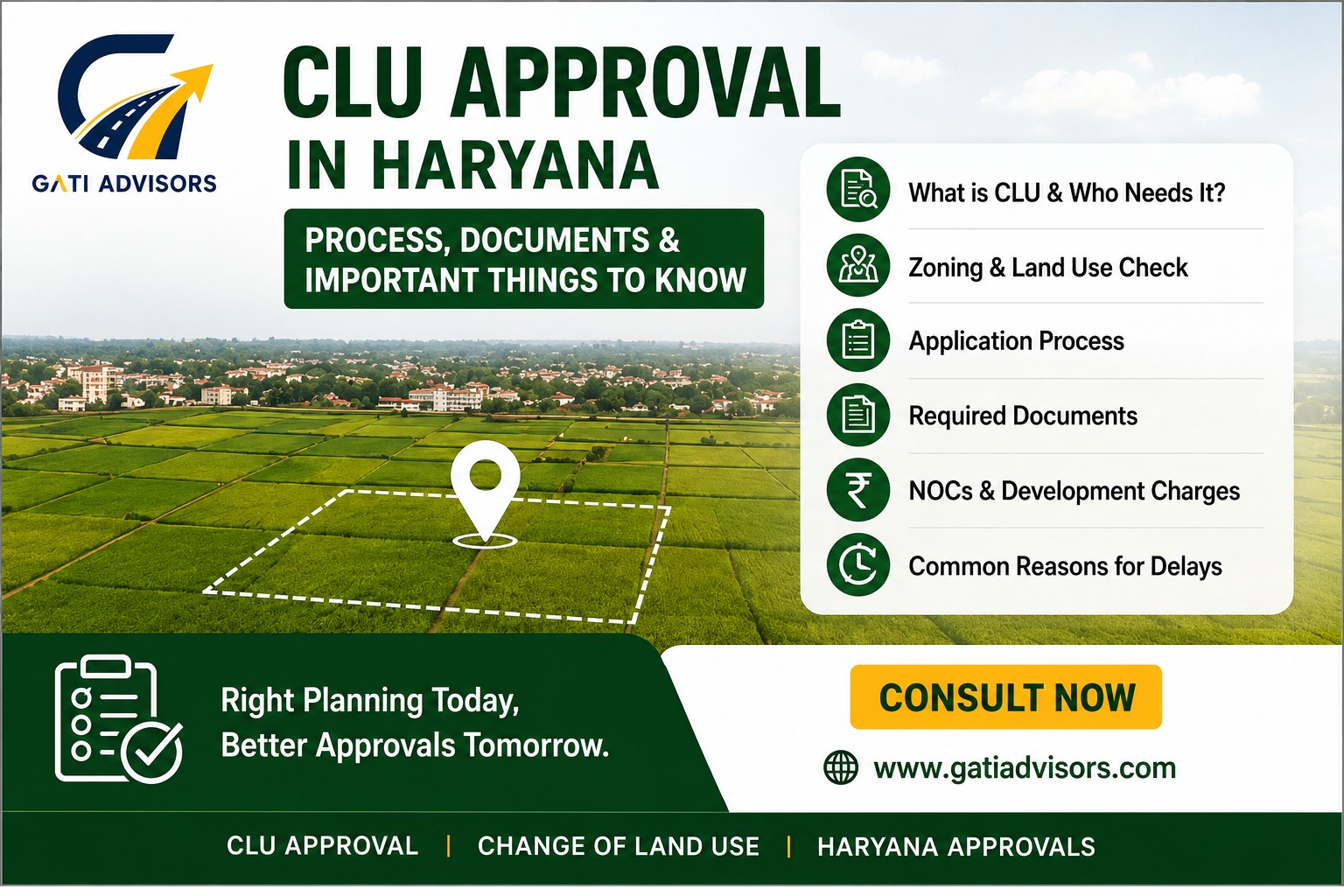
Land purchased for agricultural purposes may not automatically be suitable for every type of commercial, industrial or other development.
When a proposed development involves a change in the permitted use of land, the applicable Change of Land Use (CLU) process may become an important requirement.
In Haryana, CLU-related permissions are governed by the applicable planning laws, policies, zoning provisions and requirements of the concerned authorities.
Before purchasing land or starting development, it is important to understand whether the proposed use is permissible at that location.
What Is CLU?
CLU stands for Change of Land Use.
In simple terms, it refers to permission to use land for a purpose different from its existing or recorded use, where such permission is required under applicable planning regulations.
For example, depending on zoning and applicable rules, a proposal may involve conversion or permission for uses such as:
- Commercial development
- Industrial development
- Institutional use
- Residential development
- Other permitted non-agricultural uses
The exact eligibility depends on the location and applicable planning framework.
Why Is CLU Important?
Using land for a development without obtaining the required planning permission can create regulatory and legal complications.
CLU assessment can help establish:
- Whether the proposed land use is permissible
- Whether the location falls within an appropriate zone
- Which permissions/NOCs may be required
- Applicable charges and conditions
- Development restrictions
- Additional planning requirements
Step 1: Check the Zoning
One of the most important steps is understanding the zoning of the property.
A property may be recorded as agricultural land but may fall under a planning zone where certain development uses are permitted or restricted.
Therefore, land-use feasibility should be checked before assuming that CLU will be available.
Step 2: Verify Land Records
Important documents may include:
- Registry/Sale deed
- Jamabandi
- Mutation/Intkal
- Khasra details
- Killa details
- Mustil details
- Sajra/Aks-Shajra
- Site location documents
The land records should be consistent with the proposed site.
Step 3: Prepare the Development Proposal
The proposed use and development details need to be established.
Depending on the project, this can include:
- Site plan
- Location plan
- Proposed building details
- Access road
- Parking
- Site circulation
- Land-use details
- Project-specific drawings
Step 4: Identify Required NOCs
Different projects can require different NOCs.
Depending on the location and nature of development, these may involve departments/authorities relating to:
- Roads/highways
- Fire safety
- Environment
- Forest
- Pollution control
- District administration
- Planning authorities
- Other applicable departments
Not every project requires every NOC.
Step 5: Submit the Application
The application is prepared with the relevant documents and submitted through the applicable Haryana planning/CLU process.
Step 6: Scrutiny and Objections
The concerned authority may examine the proposal and raise observations.
Common issues may include:
- Incomplete land records
- Incorrect site details
- Zoning mismatch
- Missing NOCs
- Incomplete drawings
- Access-related issues
- Document discrepancies
The applicant may then need to submit clarification or additional documents.
Step 7: Permission and Conditions
If the proposal meets the applicable requirements, the competent authority may grant the relevant permission subject to applicable conditions and charges.
Important Things to Check Before Buying Land
If you are purchasing land specifically for commercial or industrial development, consider checking:
1. Zoning
Is the proposed use permitted in the area?
2. Road Access
Does the property have suitable legal access?
3. Highway Restrictions
If the property is near a National Highway, does the proposed access require NHAI permission?
4. Land Records
Are ownership and revenue records clear and consistent?
5. Required NOCs
Which departmental approvals will be needed?
6. Development Costs
Are there applicable CLU, development or other charges?
7. Site Constraints
Are there restrictions related to road width, ROW, environment, drainage or other factors?
CLU and Highway Access
For highway-side properties, CLU and highway access can be separate but interconnected aspects of a project.
For example, a commercial project may require:
Land-use permission → Development approvals → Highway access permission → Other applicable NOCs
The exact sequence can vary depending on the project.
Common Mistakes
Avoid:
- Purchasing land without checking zoning
- Assuming agricultural land can automatically be converted
- Ignoring highway access requirements
- Preparing drawings without checking site conditions
- Submitting inconsistent land documents
- Starting construction before obtaining required permissions
How Gati Advisors Can Help
Gati Advisors provides consultancy support for CLU and government approvals in Haryana.
Our services can include:
- Preliminary land-use assessment
- Document review
- CLU application support
- NOC coordination
- Highway access consultancy
- Objection compliance
- Government approval coordination
FAQs
Is CLU required for every property in Haryana?
No. The requirement depends on the proposed use, location, zoning and applicable planning regulations.
Can agricultural land be converted into commercial use?
It may be possible in eligible cases, subject to zoning, planning regulations and approval from the competent authority.
Should CLU feasibility be checked before purchasing land?
Yes. This is a prudent step if the purchase is being made specifically for a proposed commercial, industrial or other non-agricultural development.
Does CLU automatically provide NHAI access permission?
No. Highway access permission is a separate regulatory matter where applicable.
Need CLU Assistance in Haryana?
Planning a commercial, industrial, residential or other development in Haryana?
Before investing heavily in the project, get the land-use and approval requirements assessed.
Contact Gati Advisors for CLU consultancy, NHAI access permission and government approval assistance in Haryana.