
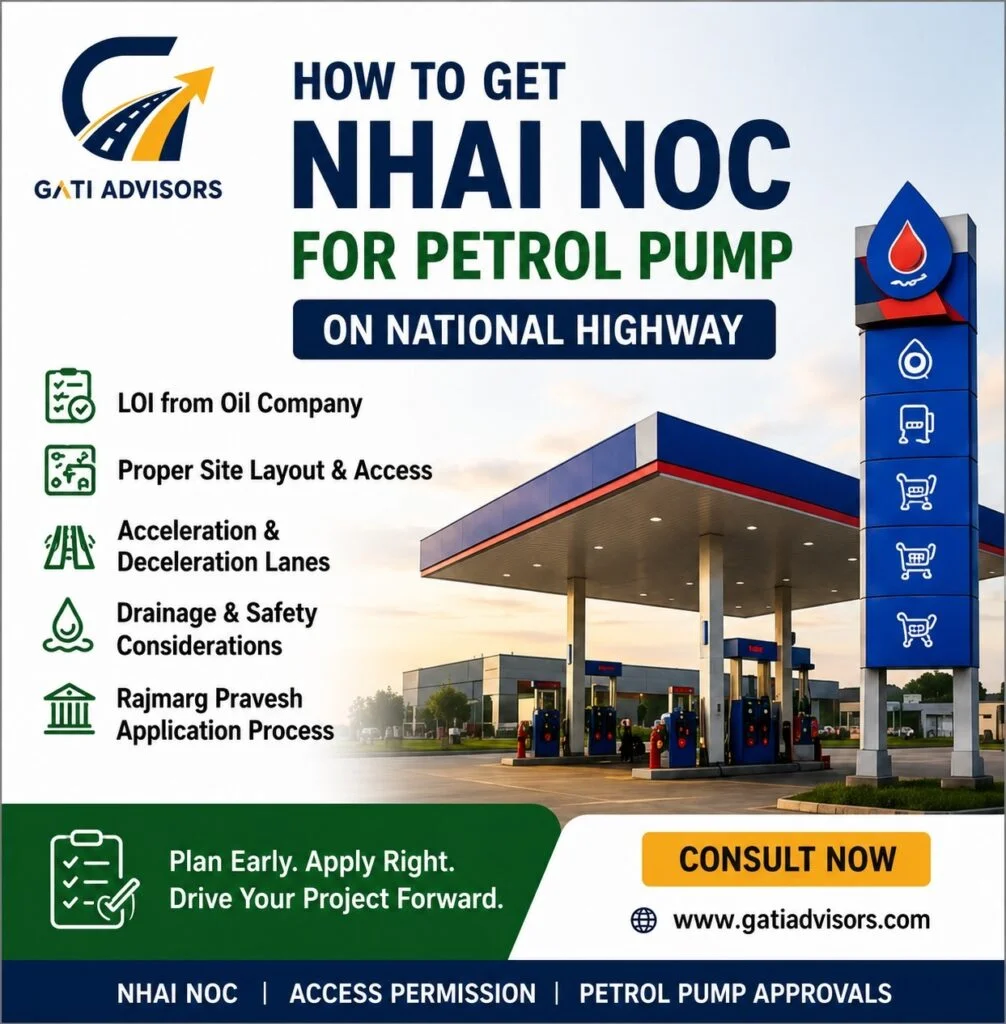
Setting up a petrol pump on or near a National Highway involves several regulatory and technical approvals. One important aspect is obtaining the required permission for access from the highway.
A petrol pump may have a well-designed plot and valid land documents, but its proposed highway entry and exit must also satisfy the applicable access and road-safety requirements.
Therefore, NHAI access planning should ideally be considered at the beginning of the petrol pump project.
What Is NHAI NOC for a Petrol Pump?
An NHAI NOC/permission for a petrol pump relates primarily to the proposed access arrangement connecting the fuel station with the National Highway.
The proposal can involve assessment of:
- Site location
- Highway chainage
- ROW
- Existing intersections
- Access location
- Entry and exit arrangement
- Service road requirements
- Acceleration/deceleration arrangements
- Drainage
- Road geometry
- Traffic safety
The exact requirements depend on the site and applicable norms.
Why Is Highway Access Important for a Petrol Pump?
A petrol pump generates regular vehicle movements. Poorly planned access can create conflicts between highway traffic and vehicles entering or leaving the fuel station.
Proper access planning helps address:
- Safe vehicle movement
- Entry and exit visibility
- Traffic conflict points
- Drainage
- Road geometry
- Integration with existing highway infrastructure
Documents Commonly Required
A petrol pump access/NOC proposal may require documents such as:
Land Documents
- Sale deed/registry
- Lease deed, where applicable
- Latest Jamabandi
- Mutation/Intkal
- Khasra/Killa/Mustil details
- Relevant ownership or possession documents
Applicant Documents
- Aadhaar/PAN, where applicable
- Company documents
- GST details
- Authorization letter
- Power of Attorney, where applicable
Petrol Pump Documents
- Oil company LOI/dealership-related document
- Proposed site details
- Fuel station layout
- Relevant approvals/NOCs
Technical Documents
- Site location plan
- Layout drawing
- Highway alignment
- Chainage
- ROW details
- Entry/exit proposal
- Drainage arrangements
- Relevant road geometry
Additional documents may be requested by the concerned authority.
Petrol Pump Layout and Highway Access Drawing
The technical drawing should clearly communicate how vehicles will move between the highway and the proposed fuel station.
Depending on the site, the drawing may include:
- NH alignment
- Chainage
- ROW
- Plot boundary
- Fuel station layout
- Entry and exit
- Service road
- Acceleration lane
- Deceleration lane
- Median/opening details, where applicable
- Existing intersections
- Nearby roads
- Drainage
- Relevant dimensions
A clear drawing can significantly improve the quality of the application.
Step-by-Step Process
1. Verify the Site
First, verify the highway, location, chainage, ROW and existing access conditions.
2. Check Land Documents
Ensure that ownership and land records correspond with the proposed site.
3. Prepare the Technical Proposal
Prepare the required layout and highway-access drawings.
4. Compile Supporting Documents
Collect land, applicant, oil-company and technical documents.
5. Submit the Application
Submit the proposal through the applicable NHAI process/portal.
6. Technical Scrutiny
The concerned authority reviews the proposal.
7. Address Objections
If observations are raised, provide revised documents, drawings or clarifications.
8. Approval/NOC
After satisfying the applicable requirements and completing necessary formalities, the relevant permission/NOC may be issued.
Common Mistakes in Petrol Pump Access Applications
Some frequent problems include:
- Incorrect chainage
- Incomplete site layout
- Missing ROW
- Poorly represented entry/exit
- Missing drainage details
- Incomplete land documents
- Inconsistency between documents and drawings
- Missing authorization documents
- Not showing nearby intersections or access points
- Submitting drawings without adequate technical details
Can a Petrol Pump Be Approved on Any Highway-Side Plot?
No. A highway-side location does not automatically mean that direct access will be permitted.
The suitability of access depends on the site, highway characteristics, existing road infrastructure, safety considerations and applicable requirements.
Therefore, site feasibility should ideally be checked before making major investment decisions.
How Gati Advisors Can Help
Gati Advisors provides consultancy support for NHAI access permission and highway-related approvals.
Our assistance can include:
- Preliminary site assessment
- Document checklist
- NHAI access application support
- Coordination for technical drawings
- Application submission assistance
- Objection compliance
- NHAI NOC-related consultancy
FAQs
What documents are needed for petrol pump NHAI NOC?
Land documents, oil company documents, applicant/company documents and technical drawings are commonly required. The exact list varies by project.
Is an oil company LOI required?
For petrol pump projects, the relevant oil company/dealership documentation is generally an important part of the project documentation.
Can Gati Advisors help with NHAI objections?
Yes. We assist clients in reviewing observations and coordinating the required compliance.
Should NHAI access be checked before purchasing land?
It is strongly advisable to evaluate highway access feasibility before committing significant investment to a highway-side petrol pump site.
Planning a Petrol Pump?
If you are planning a petrol pump on a National Highway, don’t wait until the last stage to address highway access.
Contact Gati Advisors for professional assistance with NHAI access permission, NHAI NOC, documentation and objection compliance.